

Important warning
The manufacturing and use of chlorine dioxide (CDS) require strict precautions. It is essential to handle the substances in a well-ventilated environment, with adequate protection (gloves, safety glasses, mask). Chlorine dioxide is a powerful chemical that can pose health risks if mishandled.
Find all the necessary equipment for the production of your CDS using the jar method on our website.
Materials Needed
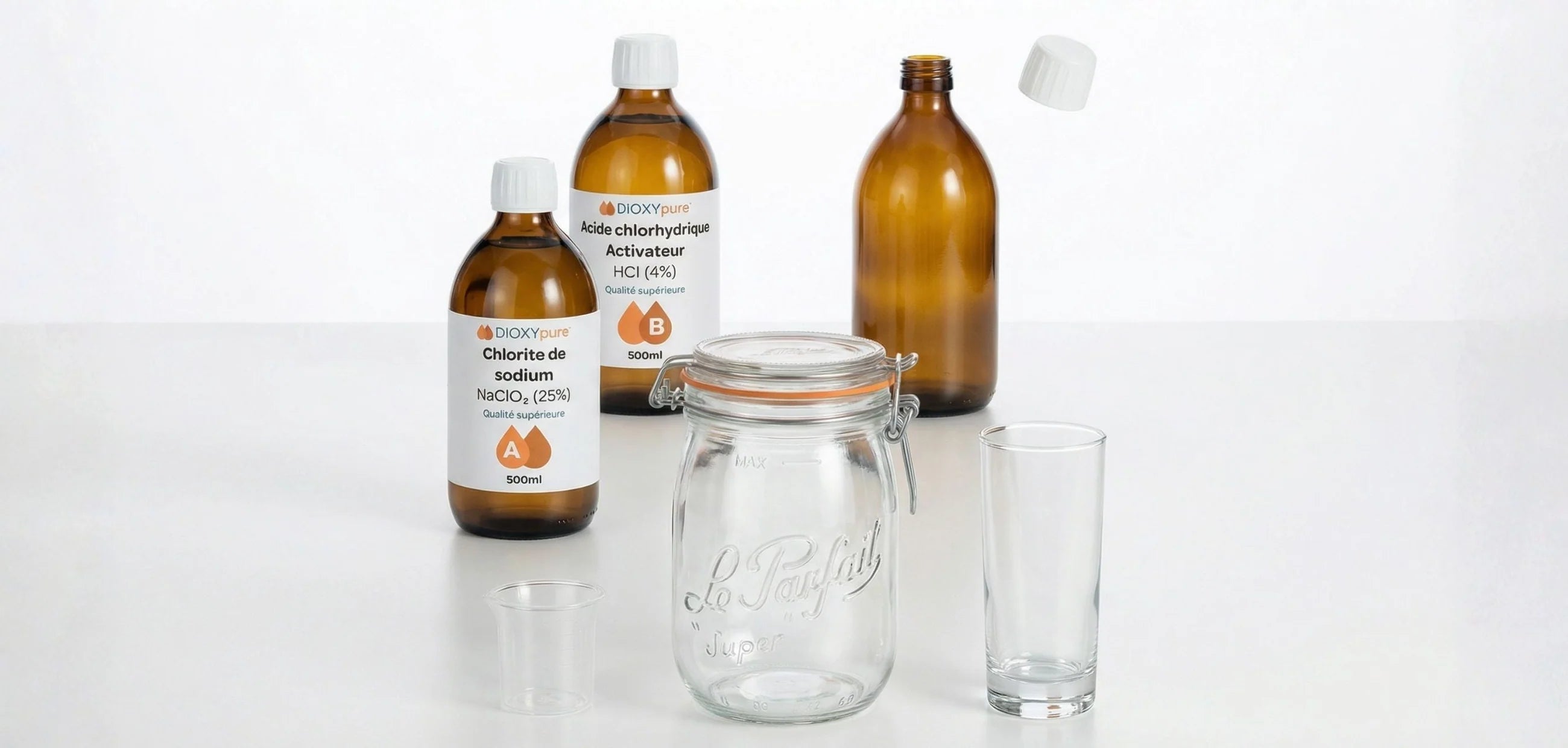
To make CDS using the JAR method, you will need:
•An airtight glass jar (like a canning jar)
•A small glass
•Low-mineral or distilled water (variable quantity depending on desired dosage)
•Hydrochloric acid (HCl) at 4%
•Sodium chlorite (NaClO2) at 25%
•A cup or a graduated syringe for dosing
•A well-ventilated area away from any heat source
•Gloves and protective eyewear
Tutorial: How to make your own CDS?
Dosages
The quantities of distilled water and reagents vary depending on the concentration and amount of CDS you wish to obtain. Please refer to the dosage table to precisely adjust the proportions. The dosages given here are indicative and should be adapted according to your needs.
What is the CDS?
CDS (Chlorine Dioxide Solution) is a solution that contains only chlorine dioxide gas dissolved in distilled water. It is essential that the reactants (sodium chlorite and hydrochloric acid) are never mixed directly with the distilled water in the jar. If the reactants come into contact with the water, this would result in a solution containing reactants, which is not CDS. Chlorine dioxide gas must be generated separately and dissolved in water to obtain the CDS solution.
Walkthrough
Step 1: Jar Preparation
•Fill the jar with the amount of water corresponding to your dosage.
•Place the small glass in the jar.
Step 2: Preparing the reactive mixture
•In the small glass, first add the 25% sodium chlorite.
•Then, gently add the 4% hydrochloric acid to the cup, but never allow these reagents to come into contact with the water in the jar. They should only interact with each other in the small glass, not in the water.
Step 3: Chlorine dioxide formation
•Immediately close the jar tightly. The chlorine dioxide gas is released into the small glass and slowly dissolves into the water in the jar.
Step 4: First saturation (approx. 24 hours)
•Leave for 24 hours at room temperature in a dark place.
Step 5: Refrigeration after the first saturation
•After 24 hours at room temperature, place the jar in the refrigerator.
•Check that the color of the cup and the color of the water in the jar become identical. This means that the reaction is complete and the chlorine dioxide is properly dissolved in the water.
Step 6: Second saturation (approx. 24 hours)
•Once the color is consistent between the small glass and the liquid in the jar, discard the contents of the cup and prepare a new reactive mixture with the same proportions.
•Seal the jar tightly and leave it to act for another 24 hours.
•Repeat the same check: after 24 hours, place the jar in the refrigerator and wait for the color of the small glass and that of the water in the jar to be identical.
Step 7: Filtration and Storage
•Once the time for the second saturation has elapsed, carefully open the jar.
•Transfer the resulting solution into an amber glass bottle with an airtight stopper.
•Store the solution in the refrigerator.
Precautions and Storage
-> Safe Handling: Never inhale chlorine dioxide fumes directly.
-> Storage: Keep the solution in a dark glass container, in a cool place, in the refrigerator, and away from light.
Note
This guide is for informational purposes only. Any handling is at your own risk. Make sure to observe all necessary safety standards.
This method involves risks and dangers. We are absolutely not responsible for any improper execution of this method, and you must take all necessary precautions to ensure your safety.


Chlorine Dioxide - Production Kit - Large Format
In stock
Share this product